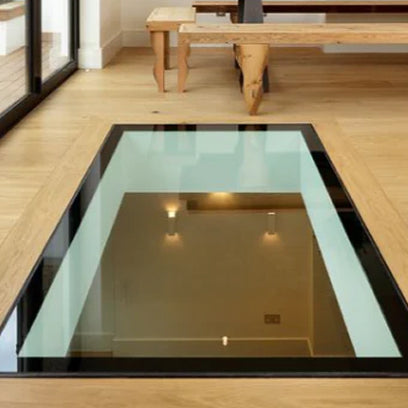
Basement light wells do an important job. They channel daylight and ventilation into rooms that sit below ground level. But leave a light well uncovered and you've got an open void in your property. Fall hazard. Rainwater collector. Leaf trap. Weak point in the whole building's weatherproofing.
A glass well cover fixes all of that at once. Seals the opening. Bears the load of people walking over it. Lets light through to the basement below. And it does it without the industrial aesthetic of a metal grate bolted over the top.
Here's what you should know before ordering one.
Why Glass Instead of Metal or Plastic?
Traditional options are metal grates, steel mesh panels or plastic domes. They all work, to a point. But every one of them compromises somewhere.
Metal grates chop up the light. Bars cast shadows into the basement. Give them a few years and they rust, collect debris between the slats, and start looking rough. Plastic domes go yellow from UV exposure and can't take foot traffic. So they end up cracked, discoloured and replaced.
Toughened laminated glass transmits nearly all available daylight while supporting the weight of people walking across it. It's weather-resistant, structurally rated, and maintains clarity for decades. Not years. Decades. No other material genuinely does everything at once.
Safety Standards and Load Ratings
Glass well covers installed in walkable areas have to meet specific safety standards. Here are the ones that matter in the UK.
BS EN 1991-1-1:2002. This sets the loads that floor-level glass must withstand. Uniform distributed loads of 1.5 kN/m² and concentrated point loads of 2.0 kN. Any glass well cover described as "walk-on" should meet these. If a supplier can't confirm it, walk away.
Toughened and laminated construction. Building regs require that glass in locations where someone could fall through it must be laminated. Lamination keeps the glass together on impact. Even if it fractures, nobody falls through. Our glass well covers use three layers of 10mm toughened glass with EVA interlayer for exactly that reason.
Steel framework compliance. The supporting steel frame needs to be structurally rated too. UKCA-marked frameworks built to BS EN 1090 standards. At Bespoke Glass Products, every steel frame is custom-fabricated, powder-coated, and arrives with pre-drilled fixing points ready to go.
Choosing the Right Specification
Standard vs Insulated
The standard 33mm glass well cover is three layers of laminated toughened glass in a steel frame. For most outdoor basement light wells where both sides of the glass are exposed to open air, this is the right pick.
The insulated version adds a secondary 6mm toughened pane sealed underneath with a 15mm warm edge spacer bar. That sealed cavity acts as a thermal break. Stops condensation forming on the underside and cuts heat loss. If the basement below is heated, or if moisture on the glass would be a problem, the insulated version should be your default.
Fire Rating
Multi-occupancy buildings and commercial properties sometimes need fire compartmentation that extends to floor-level glazing. Our 33mm glass well cover is available with 30-minute or 60-minute fire integrity ratings. Not sure if yours needs it? Your building control officer or architect will know.
Anti-Slip Coatings
Outdoor installations in the rain need grip. A quality anti-slip treatment exceeds the standard Pendulum Test Value threshold of 36 and typically lasts around five years before reapplication. Worth adding on any cover that's exposed to the elements.
Installation Considerations
Glass well covers are designed to be straightforward to install. But a few things need to be right.
Accurate measurements. Every cover is made to your exact opening dimensions. Measure carefully. Account for where the steel frame sits. Production tolerance is ±3mm, so the numbers need to be correct first time.
Frame seating. The steel framework sits over the well opening and gets fixed in place through the pre-drilled countersunk holes. Foam sealing strip between the frame and surrounding surface creates a weathertight seal.
Drainage. Water should flow away from the glass, not pool on top of it. A slight fall in the surrounding surface helps enormously on ground-level installations. Sounds obvious, but it gets overlooked more often than you'd think.
Access requirements. Do you need to get into the well regularly? Maintenance, inspection, cleaning? Think about whether a removable or hinged installation makes more sense than permanently sealing it. Our standard covers can be screw-fixed for a secure but removable setup.
Maintenance
Minimal. Warm soapy water and a soft cloth to clean the glass. Avoid anything abrasive or chemical that could damage anti-slip coatings. Clear leaves and debris off the surface when they build up, especially in autumn.
Insulated units are maintenance-free inside the sealed cavity. The warm edge spacer prevents moisture ingress, so the internal glass faces should stay clear indefinitely.
Next Steps
Covering a basement light well? Start by measuring the opening and deciding between standard and insulated construction. From there, we can advise on the right spec for your property.
Browse our full glass well cover range, or email info@bespokeglassproducts.co.uk with your measurements and we'll get a quote over to you.