Specifying a glass rooflight for an extension or new build? Then thermal performance isn't something you can think about later. Building regulations require it. And honestly, even if they didn't, you'd want to get this right. A poorly specified rooflight bleeds heat in winter and turns rooms into greenhouses in summer.
Understanding rooflight U-values helps you pick a rooflight that actually performs. One that keeps heat where it belongs, controls energy costs, and doesn't give your building control officer a reason to reject the sign-off.
What Is a U-Value?
Simple enough. A U-value measures how much heat passes through a building element. It's expressed as watts per square metre per degree Kelvin (W/m²K). Lower number means less heat escaping. That's all you really need to remember.
But some context helps.
- A solid brick wall sits around 2.0 W/m²K
- A modern insulated wall drops to roughly 0.3 W/m²K
- Single-glazed window? About 5.0 W/m²K. Terrible
- A decent double-glazed rooflight should land between 1.2 and 1.6 W/m²K
Here's the thing people miss. Rooflights sit on the horizontal plane, or near enough. Warm air rises and hits them directly. So a rooflight with a poor U-value loses heat faster than a vertical window with the same spec. The numbers matter more here than almost anywhere else in the building envelope.
What Do Building Regulations Require?
Part L of the Building Regulations sets maximum U-values for rooflights. The current limiting values are straightforward.
- Rooflights (including glass rooflights) max 2.2 W/m²K
- Roof windows max 1.6 W/m²K
Those are worst-acceptable figures. Not targets. Any well-made rooflight should beat them comfortably.
One thing to watch for. The U-value must be calculated as a whole-unit value, not just the centre-pane figure. Some suppliers quote centre-pane numbers because they look better. But that's misleading. Centre-pane doesn't account for heat loss through the frame and edges. Building control will assess the whole-unit figure, so that's the one that counts.
How Glass Rooflight Construction Affects Thermal Performance
Several things determine where a rooflight lands on the U-value scale.
Double vs Triple Glazing
Two panes separated by a gas-filled cavity is your standard double-glazed unit. Triple glazing adds a third pane and a second cavity, which cuts heat transfer significantly. Worth the investment on larger openings and in colder parts of the country. On a small rooflight in a mild climate? Probably overkill. On a 2m² panel in Yorkshire? Absolutely worth it.
Argon Gas Fill
Argon conducts heat more slowly than air. Filling the cavities with it is standard practice among quality manufacturers. It's not an upgrade or an add-on. If someone's charging you extra for argon fill, that should raise questions.
Warm Edge Spacer Bars
The spacer bar sits between the glass panes at the edge. Old-school aluminium spacers conduct heat like nobody's business, creating a thermal bridge right around the perimeter. Warm edge spacers use materials with much lower thermal conductivity. Less heat loss at the edges. Less condensation forming around the glass. It's a small component that makes a noticeable difference.
Low-Emissivity (Low-E) Coatings
A microscopically thin metallic coating on one or more glass surfaces. It reflects heat back into the room instead of letting it pass through. Probably the single most effective way to improve a U-value without adding extra weight or thickness to the unit.
What This Means When You're Ordering
When you're specifying a glass rooflight, four questions will tell you most of what you need to know.
- What's the whole-unit U-value? Not centre-pane. The full installed unit
- Is argon fill included as standard? It should be. Full stop
- What spacer bar type? Warm edge outperforms aluminium every time
- Is triple glazing an option? For larger panels or high-performance builds, it matters
Our frameless glass rooflights come with double or triple glazing, argon-filled cavities and warm edge spacer bars as standard. Every unit's made to your exact dimensions, so you're not compromising between thermal performance and fit.
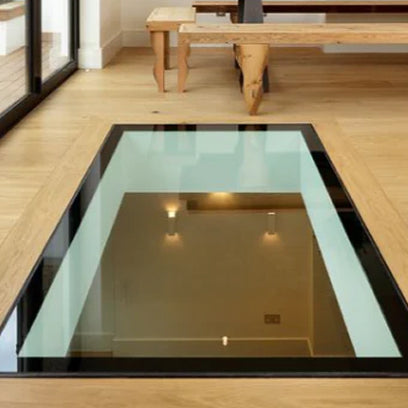
For projects where the rooflight also needs to handle foot traffic, our walk-on glass rooflights use a stepped insulated construction. Three layers of 10mm toughened glass with EVA interlayer, sealed with a warm edge spacer to a secondary pane. Structural strength and thermal insulation in one unit.
A Note on Grey Tinted Glass
South-facing rooflight? Direct sunlight for hours on end? Solar heat gain becomes a real problem, fast. A grey tint reduces glare and the amount of solar energy passing through without killing your natural light levels.
It doesn't directly affect the U-value (that measures heat going out, not coming in), but it makes a tangible difference to thermal comfort. Especially in open-plan spaces and extensions where overheating turns a nice room into an unusable one by 2pm in July.
Summary
Getting the thermal spec right on a glass rooflight isn't complicated. But it does need attention. The U-value tells you how well the unit holds onto heat. Part L sets the legal floor. And the construction details, the glazing layers, the gas fill, the spacers, the coatings, determine where your rooflight actually sits on that scale.
Not sure which specification suits your project? Email us at info@bespokeglassproducts.co.uk. We manufacture every rooflight in-house and we'll talk you through the right build-up for what you're trying to achieve.
Browse our full range of glass rooflights and glass skylights, including frameless, walk-on and switchable options. All made to measure with 10-day dispatch.