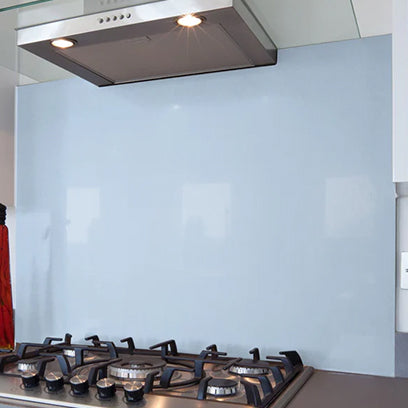
It is the first question everyone asks. You love the idea of a mirror splashback behind a hob, but you are not sure whether heat and reflective glass are a combination that actually works. Fair concern. Standard mirror glass and a gas flame would be a genuinely bad idea. But toughened mirror glass? Completely different story.
The short answer is yes. A toughened mirror glass splashback is entirely safe to use as a mirror splashback behind a hob. Gas, electric, induction. All of them. Here is why.
Toughened Glass vs Standard Glass
The difference is in how the glass is made. Toughened glass, sometimes called tempered glass, has been heated to approximately 620 degrees Celsius and then rapidly cooled in a controlled process called quenching. This changes the internal structure of the glass and makes it roughly five times stronger than standard glass of the same thickness.
That toughening process also makes the glass heat resistant. Our mirror splashbacks are rated to withstand sustained temperatures up to 400 degrees Celsius. For context, a domestic gas hob produces surface temperatures of around 200 to 250 degrees Celsius. An induction hob sits even lower. You have a significant safety margin.
Standard mirror glass, the kind you would buy for a bathroom mirror, has not been through this process. It can crack under thermal shock when exposed to sudden heat changes. That is why it is crucial to always check that a mirror splashback behind a hob is specifically labelled as toughened before fitting.
What Happens if Toughened Glass Does Break?
On the rare occasion that toughened glass breaks, it shatters into small, roughly cube-shaped pieces rather than dangerous jagged shards. This is a designed safety feature. Standard glass breaks into large, sharp fragments that can cause serious injury. Toughened glass significantly reduces that risk.
In practice, toughened mirror splashbacks very rarely break from heat alone. The most common cause of breakage is physical impact, like accidentally hitting the glass with a heavy pan. Even then, the toughening process means the glass absorbs far more force before failing.
Gas, Electric, and Induction. All Safe.
There is no difference in safety between hob types when using a toughened mirror splashback behind a hob. Gas hobs produce a visible flame, which looks closer to the glass, but the actual surface temperature at the splashback is well within tolerance. Electric hobs radiate heat more evenly, and induction hobs generate heat in the pan itself, meaning the splashback receives minimal direct heat at all.
For more detail on glass and heat, our earlier guide on glass splashbacks and heat resistance covers the science in full.
Will Heat Discolour a Mirror Splashback?
No. The reflective coating on a toughened mirror splashback is applied to the back of the glass and sealed during the manufacturing process. It does not yellow, blister, or degrade under normal kitchen heat exposure. Compare that to paint, which blisters and peels behind a hob within months, or tiles, where the grout can discolour from repeated heat exposure.
All Three Finishes Are Heat Rated
This applies equally to every mirror finish in our range. The toughened mirror glass splashback in classic silver, the grey mirror glass splashback, and the bronze mirror splashback are all manufactured from the same toughened glass. The colour tint is in the glass itself, not applied as a surface coating, so it has no effect on the heat resistance rating.
Fitting Tips for Behind a Hob
When fitting a mirror splashback behind a hob, leave a gap of approximately 3 to 5 millimetres between the bottom edge of the glass and the hob surface. This allows for a neat bead of silicone sealant and avoids any pressure points where the glass sits on the hob frame.
Use neutral-cure silicone adhesive only. Acidic silicone can react with the mirror coating and cause dark spots to appear over time. Your wall surface should be flat, dry, and free from loose plaster or old tile adhesive.
Once fitted, maintenance is minimal. For the full cleaning routine, see our guide on how to clean a mirror splashback.
Ready for a Mirror Splashback?
Toughened to 400 degrees. Safe behind any hob. Made to your exact measurements.
Shop mirror splashbacks or call us directly on 01695 280 981