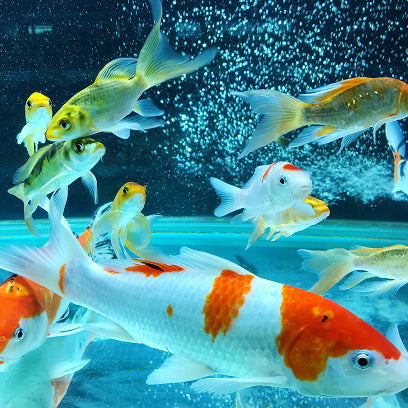
Koi fish jumping out of water is almost never random. It's a response to something wrong in the pond, and the behaviour itself is a signal worth taking seriously.
Fish don't leave a healthy, stable pond voluntarily. That's the starting point. The causes are wide-ranging. Some are straightforward chemistry problems. Others involve predator disturbance or the fish's own seasonal behaviour, and identifying the right one determines whether the fix takes ten minutes or a full pond review.
Is it normal for koi to jump?
Occasional surface activity at feeding time is normal. Koi regularly attempting to clear the pond rim is not. One incident in a well-managed pond might be coincidental. A pattern is a sign something is wrong, and it's worth treating it as such rather than assuming the fish will settle.
The Most Common Reasons Koi Jump
Six triggers account for the vast majority of cases. Poor water quality and low dissolved oxygen are the most frequent, and often the most urgent to address. Spawning behaviour, predator disturbance, overcrowding, and sudden environmental changes cover most of the rest. The cause matters because each one calls for a different response.
Poor Water Quality
The problem with water quality failures is that you often can't see them coming. Ammonia above 0.25 mg/L is enough to cause acute gill irritation in koi, and nitrite is equally damaging above 0.1 mg/L. Neither makes the water look wrong. A pond can be running dangerous chemistry while still appearing as clear as it ever has, and overfeeding is one of the fastest ways to get there without realising.
Test first. That's the rule when koi start jumping unexpectedly. Ammonia, nitrite, pH, and KH together will tell you what the eye can't.
Low Dissolved Oxygen
A pond that looked fine at 6pm can be a problem by 4am. Dissolved oxygen falls as temperatures rise, and the drop accelerates overnight because submerged plants reverse their function after dark, consuming oxygen rather than releasing it. Below 6 mg/L, koi feel it. In a poorly aerated pond, a fish on the decking in the morning is not unusual. Algal blooms make this worse much faster than most pond keepers expect.
Aeration running overnight in summer is non-negotiable for a koi pond. Not a precaution. A requirement.
Why is my koi jumping at night?
The hours before dawn are when dissolved oxygen levels hit their floor. Plants and algae that produce oxygen during the day do the opposite at night, and in a pond without adequate aeration, that matters by 3am far more than it did at dusk. If fish are consistently turning up on the decking in the morning, check what your aeration is doing overnight before assuming anything else. Test dissolved oxygen levels early, before the water warms up, and look at running an air stone or fountain pump through the night.
Spawning Behaviour
Between late May and early July, male koi pursue females persistently. The chase is sustained and exhausting for the females, and fish jumping to escape that pressure is a recognised part of spawning behaviour. If multiple fish are jumping in warm weather and your pond holds a mixed-sex population, spawning is a more likely explanation than a water quality problem.
The behaviour resolves on its own once spawning is complete. But a fish that clears the rim at 3am won't survive on paving until morning.
Do koi jump during spawning?
Yes, and it's one of the most frequently misdiagnosed causes of koi fish jumping out of water. From late May through to early July, males chase females intensively around the pond. Females under sustained pressure will jump to escape. If multiple fish are jumping in warm weather and your pond has both sexes, spawning is the most likely cause. The behaviour settles once spawning completes, typically within a few weeks.
Predator Disturbance
A heron at the water's edge doesn't need to catch a fish to cause chaos. The presence of a predator sends the whole pond into a panic response, and koi bolting from cover can clear the rim in the process. Most predator visits happen before dawn, which means the evidence is typically a missing fish with no obvious explanation rather than a witnessed attack.
Overcrowding
A stocking density above around 25cm of fish per 1,000 litres pushes water chemistry in the wrong direction and creates persistent low-level stress. More fish means more ammonia. That's the straightforward part. What catches people out is time. A pond correctly loaded three years ago is often running at its chemical limits now, because the fish that were 25cm when you bought them may be 50cm or more by this point. Stocking rules are based on fish length, not headcount. Volume needs to scale accordingly.
Sudden Environmental Changes
Put untreated mains water directly into a koi pond and you're adding chlorine at a concentration koi gills aren't built to handle. The response is immediate. Heavy rainfall off treated paving works on the same principle, just at a lower dose. If jumping started the same afternoon as a water change, or after a downpour, that's where to look. Not the filter. Not the fish.
Can koi survive after jumping out of the pond?
Two or three minutes is roughly the window before things get critical. Koi gills need moisture to function, and a dry surface closes that window fast. Wet stone close to the pond edge buys time. A fish found the following morning on a dry patio usually doesn't make it back. And even ones that return to the water looking fine can develop infections from the impact over the following days. Keep watching them.
How to Stop Koi Jumping Out of the Pond
Address the underlying cause first. Weekly water testing catches chemistry problems before fish start jumping. Stocking levels need reviewing as fish grow, because a pond correctly loaded three years ago may not be now. Running aeration overnight through summer eliminates the oxygen crash risk that catches most pond keepers by surprise.
Once the water is stable, the remaining risk is physical, and it needs a physical solution.
Netting is the traditional recommendation, but it covers the pond surface entirely, which creates ongoing maintenance problems and changes the look of a pond that has had real investment put into it. Our comparison of pond jump guards vs netting covers that trade-off in full.
Glass pond jump guards fix vertically around the inside of the pond rim using stainless steel posts and clamps from our pond glass fittings range, creating a barrier at the edge without covering the water. Panels are cut from toughened safety glass to the exact dimensions of your pond perimeter, including irregular shapes and internal corners. They work with any koi pond design and leave the view of the water completely unobstructed.
What height do pond jump guards need to be for koi?
300mm is the minimum for a koi pond. Standard heights are 250mm and 300mm, and for koi, particularly larger specimens, 300mm provides the necessary clearance. The toughening ratio governs panel length: a 300mm-high panel should not exceed 3 metres, which determines how your pond perimeter is divided into sections when specifying the installation.
If you'd like to specify pond jump guards for your pond, get in touch with Bespoke Glass Products to discuss panel sizing and get a made-to-measure quote.