Both prevent koi from jumping out of the pond. That's the only thing they have in common. The difference between pond jump guards and netting isn't subtle, and for anyone who has spent real money on a koi pond, it matters considerably.
How Each One Works
Pond netting is laid horizontally across the pond surface. It creates a ceiling above the water that fish cannot clear. It also catches leaves and debris as they fall, which sounds useful until you realise how much work that generates.
Glass pond jump guards work from the perimeter. Panels of toughened safety glass are fixed vertically around the inside edge of your pond rim using stainless steel posts and clamps from our pond glass fittings range. If a koi jumps, the glass stops it and the fish drops back into the water. The pond surface itself stays completely open.
Why do koi jump out of ponds?
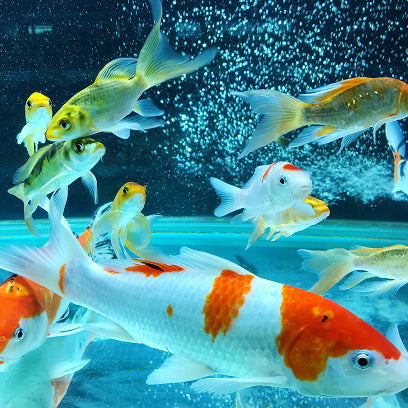
Koi jump for several reasons, and understanding them matters because the problem is rarely a one-time event. Poor water quality is the most common trigger. When ammonia or nitrite levels spike, koi become acutely stressed and jumping is a physiological response. Dissolved oxygen levels dropping below around 5mg/L produce the same effect. Spawning behaviour, which typically peaks in late spring and early summer, causes males to chase females hard around the pond, and fish clearing the rim during that period is not unusual. A newly stocked pond also carries higher risk, because koi introduced to an unfamiliar environment are more likely to jump before they settle in.
The Aesthetic Difference
Netting sits on top of your pond. For a koi pond that took months to design and build, that is the problem in its simplest form. The net becomes the thing you look at. The water and the fish become secondary.
Glass pond jump guards don't cover the pond. They sit at the edge, largely invisible from a few metres away. Light reaches the surface normally, the reflections are undisturbed, and the fish are visible without a grid of netting across the view. The pond looks exactly as it was designed to look.
For a koi pond designed as a garden feature, this distinction isn't cosmetic. It's the difference between the pond working as intended and the pond looking managed.
Maintenance Over Time
Netting collects everything that falls from above. Leaves, debris, algae, bird droppings. In autumn particularly, a pond net becomes a maintenance project in its own right. The net also stretches over time. A sagging net dips toward the water surface, reducing light and restricting gas exchange. At some point it needs repositioning, and eventually replacing.
Glass panels need cleaning. That is the full maintenance requirement. No accumulation, no structural degradation. Nothing that needs replacing. Toughened glass outdoors cleans with a standard glass cleaner and stays clear.
What Each One Actually Protects Against
This is where netting has a genuine limitation worth knowing about. A koi that jumps vertically, straight up, will be caught by netting. A koi that jumps laterally, toward the edge of the pond, can still clear the rim and land on the surrounding decking or paving. The net addresses the jump. It doesn't address the edge.
Pond jump guards run around the inside edge of the pond. Wherever a fish heads when it jumps, the glass panel is the barrier.
Is pond netting safe for koi?
Standard pond netting is generally safe, but knotted or woven mesh carries an entanglement risk for a fish that jumps into it. Removing a distressed koi from mesh without causing scale and fin damage is harder than it sounds. Soft knitted netting reduces that risk but doesn't eliminate it. Glass pond jump guards don't carry that issue at all.
Longevity and Cost Over Time
Pond netting is cheap to buy initially. The ongoing cost is in maintenance, periodic repositioning, and eventual replacement. For a product that degrades outdoors, that cycle repeats.
Toughened glass does not degrade outdoors in the same way. The stainless steel fixings used for pond jump guards are corrosion-resistant. A properly installed set will outlast the pond build itself. The upfront cost is higher. The total cost over ten years is not.
Are pond jump guards better than netting?
For a koi pond, yes. The comparison isn't close. Netting is a reasonable solution for a simple goldfish pond where aesthetics aren't a priority. For a koi pond, where the fish are worth considerably more and the build has been designed to look a certain way, netting solves one problem and creates several others. Pond jump guards solve the same problem without those trade-offs.
Getting the Specification Right
Standard pond jump guard heights are 250mm and 300mm. For koi, 300mm is the recommended minimum. The toughening ratio governs panel length: a 300mm panel should be no longer than 3 metres, which determines how your pond perimeter is divided into sections when you measure up.
Panels are set 50 to 100mm inside the pond rim, with stainless steel D-clamps and posts fixed to the coping. They work with natural stone, timber boarding, and composite decking. For raised pond builds with viewing windows, jump guards sit cleanly alongside the existing glass installation. For a full walkthrough of the process, our guide on how to install pond glass covers what you need to know before you start.
Can pond jump guards be made to measure?
Yes, and for koi ponds this matters. Koi ponds are rarely simple rectangles. Off-the-shelf netting doesn't fit a complex perimeter properly, and the compromise shows. Bespoke glass pond jump guards are cut to the exact dimensions of your pond, including irregular shapes, internal corners, and changes in coping level. View our toughened glass cut to size.
Are glass pond jump guards safe around children?
Yes. Toughened glass is the same category of safety glass specified for architectural glazing and structural balustrades. The edges are polished smooth, there are no snag points, and the panels are fixed securely to stainless steel posts. Direct supervision of young children near any body of water remains necessary regardless of what protection is in place.
Get Pond Jump Guards Made to Your Exact Measurements
At Bespoke Glass Products, we manufacture glass pond jump guards cut to the precise dimensions of your pond. There's no standard size to fit around. You send us your measurements and we cut the panels to match, whether your pond is a simple rectangle, an irregular free-form shape, or something built around existing landscaping.
Our toughened glass is available in a range of thicknesses to suit your pond build and coping configuration. All panels are supplied with polished edges and paired with stainless steel fixings designed for outdoor use. The glass won't yellow, warp, or degrade over time the way netting and acrylic alternatives do. What you install is what you'll still have in ten years.
If you're replacing existing netting, we can help you specify the right panel heights and section lengths based on your pond perimeter. If you're at the build stage, our team can advise on how jump guards integrate with your coping and any existing pond glass installation.
Get in touch with Bespoke Glass Products to discuss your pond measurements and get a quote for made-to-measure pond jump guards.